Handling Anger
"Healthy anger... comes up, addresses an issue, and then moves on. " --McLaren, Karla "The Language of Emotions," p181

I'm hoping that you'll indulge me a bit by engaging in a small exercise.
First, take three measured breaths.
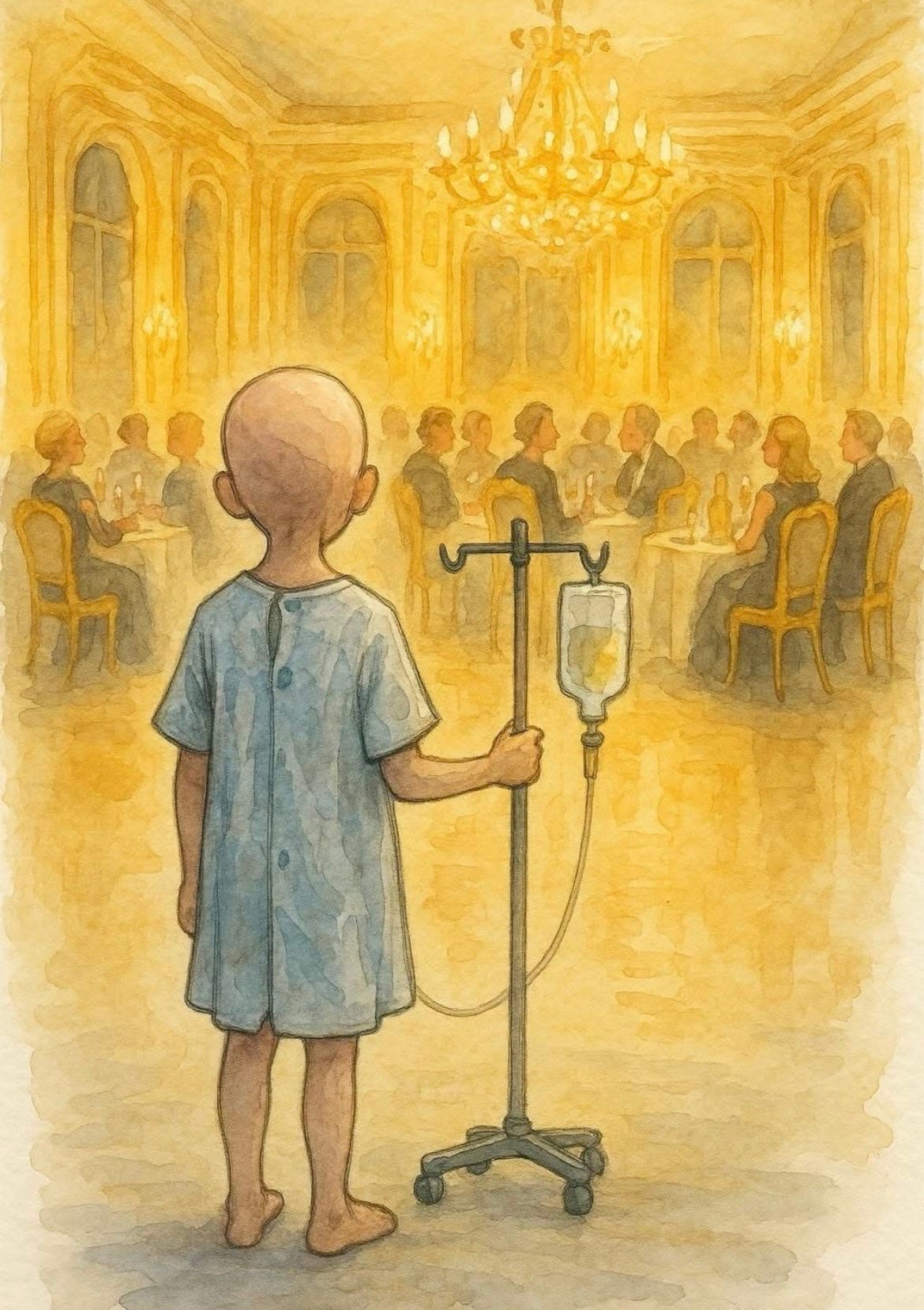
Then spend 10-20 seconds looking at the picture below.
Avoid how you are thinking, take in the situation depicted, and write down/note how you feel. Maybe put it in the comments, and come back here when you're done.
Welcome back.
Were any of you angry? sad? Anxious or fearful? Any mixed emotions?
If you are reading this, it's likely that you are exposed to images, headlines, and descriptions on a daily basis that result in some version of anger passing through your being. And if my experience is anything like yours, you might be getting tired of that emotion, as the daily onslaught and multiplication of inequities, insults, and performative outrages roll across our screens, even as we are just recovering from following up on yesterday.
This week for instance, the historian Heather Cox Richardson, who has been the voice of reason, moderation and historical context through both the first and now the second version of the Trump Regime, released an interview with fellow historian Joanne Freeman, who described her host as "ticked off" in the pre-video prep session. Ms. Cox Richardson responded by describing herself as "incandescent with rage." (The video is in this link, and her description is right at the beginning 0:30--0:40). I'll tell you what triggered her so badly later in this post.)
I'd like to explore what we do with anger. Because I think it will have a bearing on how we get through the three years ahead, and even how we prepare for a future beyond that.
The Karla McLaren quotation at the top is from her book The Language of Emotions. My wife Linda introduced to me to Ms. McLaren's work about ten years ago, when I was struggling as I sought to handle a number of what is colloquially known as "negative emotion." That book has become a go-to reference in my library.
McLaren starts right off by saying something that you have no doubt heard: there is no such thing as a "negative" emotions: all emotions are messengers. Some bring pleasant impressions; others are less pleasant. (For example: No driver likes that lurch of fear that surges when a car suddenly veers into our lane at an unsafe speed, but the driver might appreciate the warning.)
Most emotions carry messages that we either do not know how to, or do not want to, decode and read. Some of them, especially the recurring ones we have decided to/must live with, become persistent and vague, as we repress them away from our conscious life. They remain as repetitive and monotonous presences at the deeper edges of our being.
All emotions, pleasant and unpleasant, need to be accepted, welcomed and given time and space to deliver their message. They are responses to our perceptions (which may or may not be accurate), but they are honest responses, with helpful content. McLaren does cover anger that arises as an empathetic response. You don't need to have a child or grandchild who is fighting cancer to be angry with the illustration above.
Here's another little-known fact about emotions-- they often travel in pairs. Anger, for example, often has fear or sadness attached-- sometimes as a precursor, sometimes simultaneously, and sometimes after the anger has been accepted and dealt with. I'll address that dynamic in the next post.
For now, let's go to the two questions we should ask of our accepted anger: "What needs to be protected? What needs to be restored?"
Heather Cox Richardson's "incandescent rage" was triggered by two recent events.
The first was the Regime taking control of the Washington DC police force and calling up the FBI, the DEA, and the National Guard to assist the DC police in reducing a crime rate that was already at a 30-year low, according to the FBI. The Regime owns the military, and they are using it to control citizens based on an invented pretext of lawlessness that needs to be crushed and controlled. This is a precursor to using the military to suppress protest gatherings. (The Regime has announced additional plans to designate a standing military force to deal with future urban uprisings.)
What needs to be protected? The law states that it is illegal to use the US Military against citizens of the United States. What needs to be protected is the people of the United States and the rule of law.
The second trigger is mentioned at 16:46 in the video, when she describes the following: Trump's demeanor and behavior during the announcement was so disconnected and rambling that Pam Bondi and JD Vance had to take over in order to deliver the narrative elements.
Ms. Cox Richardson saw the future: Mr. Trump is becoming increasingly incapacitated. It is likely only a matter of time before JD Vance, Stephen Miller, Pam Bondi, and the rest of the Regime's Palace Guard start running the United States on the detailed destructive path of the Project 2025 Agenda. (While she did not mention the gerrymandering attempts in Texas designed to stack the midterm election results for MAGA, I'm betting it's part of the background to her dystopian vision.)
And with this anger moving to rage proportions, Ms Cox Richardson needs to ask: "What needs to be restored?" Because politics just got personal.
There's a reason she moved from anger to rage: the narrative that she successfully brought to her audience over the years is that the United States of America has been here before, pushing the authoritative envelope, enriching the few powerful, suppressing dissent, and oppressing the many... and our democracy survived the attempt. Her narrative both enlightened and comforted many of us: The extremes have been tried before, briefly succeeded, and then failed. The people of the US rose up and ensured that democracy prevailed.
What need to be restored? Ms. Cox Richardson needs to find a new workable narrative for a new set of realities.
The truth is, most of us face that every day.
After I've asked those two questions, what must I do? I'll cover that next.