I see it feelingly
Yet you see how this world goes...

Years ago, while we were living and working in Southwestern Ontario, my wife Linda and I were members of an urban Mennonite Church, whose leadership thought that we might be good leaders of a youth group; it was an interesting and brief experiment. But that is how Linda found herself walking alongside a social worker, on a guided tour through a rough part of Toronto. There were a lot of unhoused young people on those cold streets, she told me later, and some great talks afterward, as the social worker answered the youth group’s questions.
“What do you do when people on the street ask you for money?” The answer was both surprising and obvious: “I give it to them,” the social worker replied, adding that she had budgeted a daily amount of cash which she carried with her for that purpose.
“Aren’t you worried that they’ll waste it on drugs or alcohol?” That’s none of my business, the worker replied. I’m there to connect with them, not tell them what to do with it.
“What happens when you run out of that cash?”
“I still connect,” the worker replied, adding this: “Most people in this city walk past the unhoused sitting on the sidewalk without looking at them, avoiding even a glance. But people need to be seen. Even if you have no money to give, make eye contact. Let that person know that you see them as a human being.” When I heard this, it changed how I walk on a city street.
A good friend of mine who lives in Metro Seattle has been engaging in those practices for years. One of his favorite questions after he has made eye contact and exchanged a greeting is, “How are you sleeping these days? Were you able to stay dry? Did you get a good night’s sleep?”
Being seen is important; being understood is rare. My friend’s favorite questions say, “I know a bit of what you’re up against.” He gets a lot out of these brief connections, often citing one of these encounters as a highlight of his week.
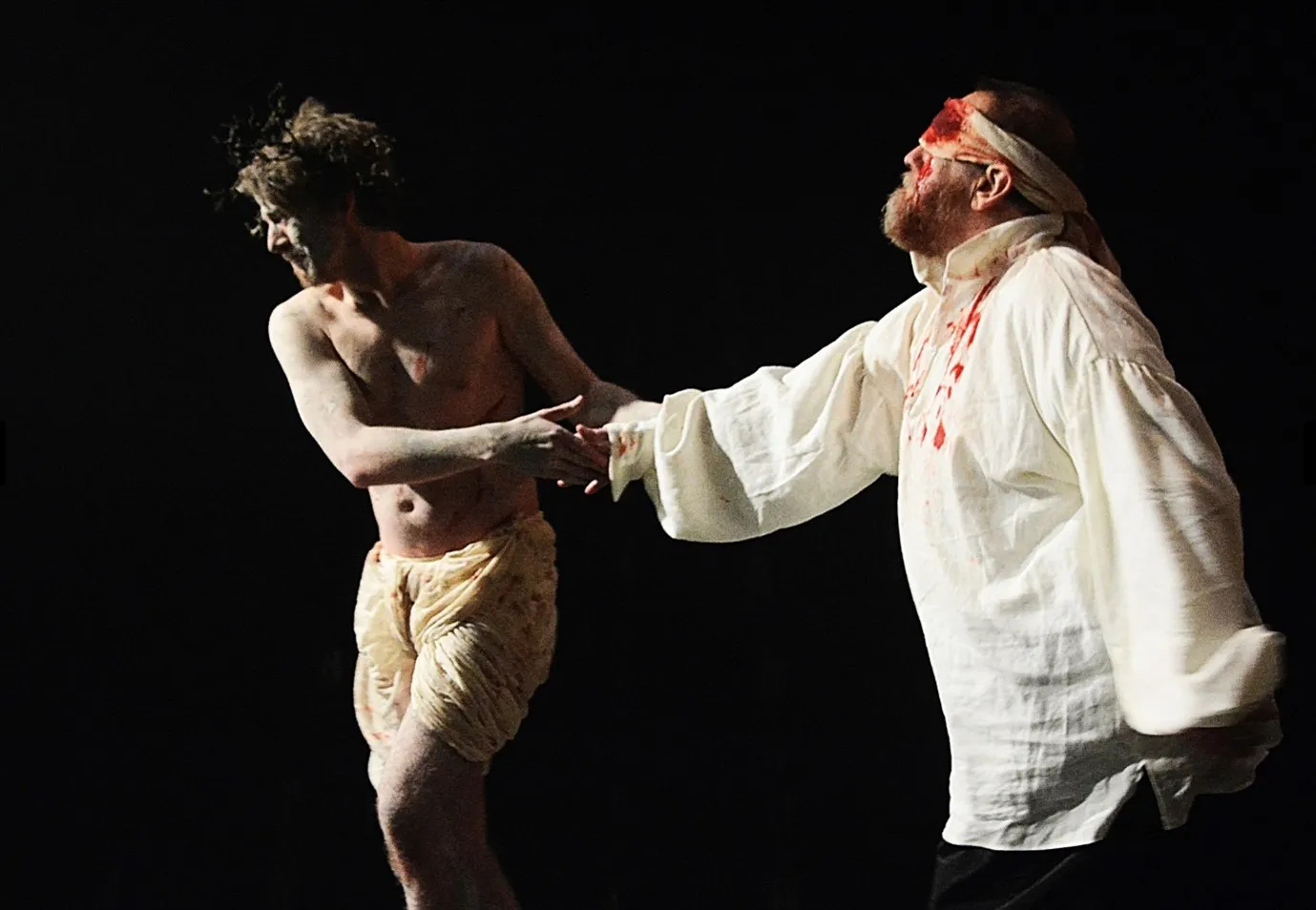
“...yet you see how this world goes.”
“I see it feelingly.”
The above quotation is an exchange between Lear and Gloucester in Act IV, scene 6 of Shakespeare’s King Lear. You may be familiar with the story. Lear is a king who has stepped down from his throne in his old age, and divided his kingdom between his eldest daughters, both of whom dishonor and abandon him. The quotation begins with Lear’s remark to his old friend and confidant the Earl of Gloucester, who has recently been tortured and blinded at the hand of Lear’s son-in-law the Duke of Cornwall. The second line of the quotation is Gloucester’s reply.
It’s about a different kind of seeing: “feelingly” is the tragic pun Gloucester uses. But there is a deep truth behind the dark laughter. We are often only enabled to see in that way only after we have recognized our inability to see in the other way.
Oh, we need that transformed type of seeing now. In this chaos, in this darkness. As I write, our country’s attention has been oversaturated with the twists and turns of a “now you’ll see it, now you won’t” public story of victimization and brutalization. Underneath all of this-- literally underneath those headlines-- are three long wars with genocidal and rapacious intent, US military executions at sea masquerading as a “war on drugs,” and citizens of the United States being kidnapped in their home towns by federal government goons, transported out of state, and detained in inhumane conditions.
It gives me no pleasure to recite this short list of of our current chaos and darkness. I do it only to point out that it is no wonder that we are in danger of losing the eyesight of our hearts, just when we most need it.
Steven Barrie-Anthony, a psychiatrist, notes the problem of witnessing this darkness through digital communications. In a New York Times opinion piece, he points out:
To tackle the problems of technology we have to return to our emotional lives for their own sake, and not always leap to doing or changing or fixing. This is the only viable pathway if we are to remain in touch with our humanness and to preserve love, empathy, emotional and spiritual richness, and the capacity to create art and music that reflect our inner lives.
Shakespeare is telling us that we are most able to have that sight of the heart when we are in touch with the loss of the eyesight on which we have previously depended.
So here, in this darkness, I am challenged to change my place of seeing. Here, in my loss, I find that there is room for another way of being. The emptiness and helplessness there helps me shift some things around.
Who near me or far away needs to be seen “feelingly”? How could I see them in such a way that they would know that they are seen? Next week provides those of us in the dark, chaotic US with an ironically bright calendar item, as we celebrate Thanksgiving. Perhaps such a holiday gathering might offer some opportunities to see familiar people in this new way. Perhaps the holiday for others can enable us to share our goods as the indigenous people did with the Europeans newly come to their shores, and unable to provide “for themselves.”
But for all of us, this feeling way of seeing --this interior question of how I might enable the person in front of me to know that they ARE seen--- is a daily challenge.
I would argue that it is a most important one to meet with my intention and my action: Perhaps not to change or fix, but to to feel and be present.
Some direct experience walking the streets of Hollywood "seeing" unhoused people. Try to learn as quickly as possible which ones are in psychosis. They can literally take you out simply because you engaged with eye contact. By analogy, the marketplace of government actors seems to hold similar dangers.
To feelingly see others is to walk in step with the one who sees and knows me (and all those I walk or drive past, pretending not to see), and yet says, “Come along now, follow me, there’s someone I want you to meet.”