See or Perish
Is there a Force behind these changes?

I started this Substack series in April 2025, with two words and three question marks (What’s Wrong???). Since then, we’ve mostly focused on how to navigate the many troubles that the US sociopolitical scene, (especially the “Culture Wars”) has visited upon its own country and the world. The posts were focused on what was being required of us, what was necessary in our responses, and how we might gather what we needed to respond in that manner, in these times.
The previous two posts have been focused differently, on the larger answer to my original two-word question. The first examined sociopolitical causes, the second, causes that are explained by modeling economic and sociopolitical pressures.
In this post, I’m engaging in what cinematographers term a focus pull: staying on the subject, but changing the plane of focus.
Is there something that is driving the changes we’ve described in the last two posts? A force that we have yet to consider? To that end, I want to introduce you to our guide and my companion Pierre Teilhard de Chardin (1891-1955), and his book The Human Phenomenon. De Chardin was a paleontologist who specialized in field work searching for and identifying early hominids. (Peking Man was among his discoveries.) Teilhard was also a Jesuit, who followed a lifelong calling to the priesthood. The Human Phenomenon is a study in the physical and spiritual development of the human species. It is scientific and theological.
This might explain why The Human Phenomenon was published posthumously in 1957, after the Vatican finally approved the manuscript’s release. here are some of its main points:
Teilhard views human evolution as a process of convergence—humanity is moving toward a collective oneness or unity. This is not only a material or biological evolution, but also an evolution of consciousness, where individuals and societies become ever more interconnected and interdependent.
He characterizes our era as potentially a “second axial period,” marked by a convergence of religious practice (e.g. Eastern and Western meditation), philosophy, and cross-cultural connection, as well as an increase in empathy and compassion. Teilhard points to the emergence of nondual consciousness—the ability to perceive reality without dualistic categories, from the perspective of wholeness and connection rather than separation and distinction.
In other words, in a Pre-Internet period, Teilhard envisioned an acceleration of human evolution, what he called a “densification,” where advances in technology and global interconnectedness drive the convergence of human energy and identity on a world-wide scale.
Since Teilhard’s first-hand experience of this accelerated human evolution ended in 1955, I’ll observe that the ubiquity of informational sources and personal interactions from across cultures and around the globe which we now enjoy has both facilitated this densification and provoked a counter-movement. When JD Vance falls in love with, marries, and has children with Usha, an ethnic East Indian, and then publicly claims that real Americans are Caucasians who have lived here for generations, that’s not hypocrisy. It is the picture of evolutionary movement and countermovement in simultaneous, unconscious action. This countermovement has travelled along racial, ethnic, and nation state lines to move human beings into identity tribes, creating echo chambers and using tribal enmity to disperse human energy.
Teilhard could already see how this convergence could be resisted. He argues that resisting this evolutionary impulse leads to stagnation or even extinction-- our inability to take climate change seriously is an example, but so is our denial that combining AI and robotics might create a new species in our image-- a more durable one— that can replace us and do a better job of running the planet.
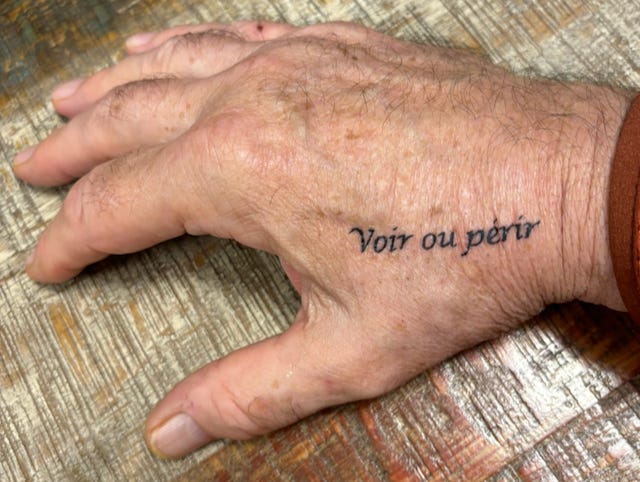
Teilhard’s vision is both a warning and an invitation: Humanity must embrace the dynamic, ongoing nature of evolution—both individually and collectively—to reach new levels of consciousness and unity, or risk falling behind and perishing. Voir ou périr is another famous conclusion from Human Phenomenon: “See or perish.“
We have enjoyed 12,000 years of climate stability on Earth, an era during which the human species, whose bodies can only thrive within an internal temperature variation of 10 degrees Fahrenheit, have flourished and developed. In the latter portion of this era, we have relied on fossil fuels to ensure that we can maintain ourselves in that state, even after our environmental science revealed that we were accelerating the rate of climate change in order to do so.
By definition, worldwide climate change is a problem that one nation and one leader alone cannot solve. The current Regime has officially and broadly decided that climate change is “a hoax.” The change coming on Planet Earth does not care who thinks what about human contribution to the change. It is coming for us all. Voir ou périr .
This larger movement of evolutionary convergence and the resisting counter movements are driving many other changes we are experiencing in liberal democracy, including those that Peter Turchin uses as ingredients in his Political Stress Index. For instance: The accelerating concentration of wealth in the hands of the few is driven by the general, albeit tacit, agreement in the US that our economic engine is not primarily a tool for social well-being, but rather the most important indicator of winners and losers. Through our inheritance tax policies, we enable a financial aristocracy and drive up the cost of living for those who cannot even afford the price of dying. The relationship between capitalism and democracy needs to be re-imagined for our age.
But how? Here are a few suggestions that may be able to take us further and in a better direction than nostalgia for Main Street Democracy:
Wherever we rebuild, whatever we are rebuilding, we must insist on the principles of human values, human scale, and human dignity. The US was the first country to build its nation on the concept that the qualification for inclusion was a desire and respect for human dignity. In overthrowing their colonial master, the founders began with “self-evident” truth that all humans are created equal, and that the purpose of Government is to uphold human rights:
We hold these truths to be self-evident, that all men are created equal, that they are endowed by their Creator with certain unalienable Rights, that among these are Life, Liberty and the pursuit of Happiness.–That to secure these rights, Governments are instituted among Men, deriving their just powers from the consent of the governed....
Capitalism and Democracy. Human dignity. What else are we looking for in this re-imagined democracy? Government needs to rely upon listening, understanding, and working together. Our governing and election systems must put patriotism before party. Government at every level needs to value individual liberty and community and encourage both process and result. It needs to refuse to establish any power without checks and balances, recognizing that humans are fallible even when they are ethical. It needs to value “both and” over “either or.” It needs to encourage unity and diversity, by understanding that while nothing is fair, everything must be just.
The list goes on, and must be open to additions. Perhaps, dear reader, you could place your own suggestions in the comments. We can (and should) all contribute to the list of ways to recognize that we’re on the right track of greater consciousness, greater love, and greater unity within individual diversity. I would love to hear what you’d like to see.
Next post: how can we individually respond to to those imperatives?
Great series, Stuart! I would add human humility. We are vulnerable creatures. It is that vulnerability that instills fear which causes us to be defensive and reach for power and control. However, if we lean in and accept our vulnerability we immediately attract those around us. We NEED each other. More than that, we are part of the humus of the earth, not rulers or masters or perhaps even stewards. Respect of our place and the Wisdom of the planet to correct itself would go a long way toward building a society or local culture which thrives. Our native brothers and sisters know some of this.
I’m sure you see the parallels between your writing and Cynthia Bourgeault’s.