Sometimes you rage, sometimes you weep.
Do not waste your anger on bad-hearted people.

My last post was inspired by a friend, an American citizen of Lebanese descent. My friend’s written response to Israel’s recent and brutal invasion of Lebanon was an expression of speechless horror: “I can do nothing but bear witness,” she wrote.
But “bearing witness” is doing something. What is it that we are doing?
The tragic gap, you may recall, is the difference between what you know to be right and what is happening. When we experience that gap, as my friend did, there is a quiet invitation to bear witness. She heard it. How does one respond to that invitation, and what does it mean?
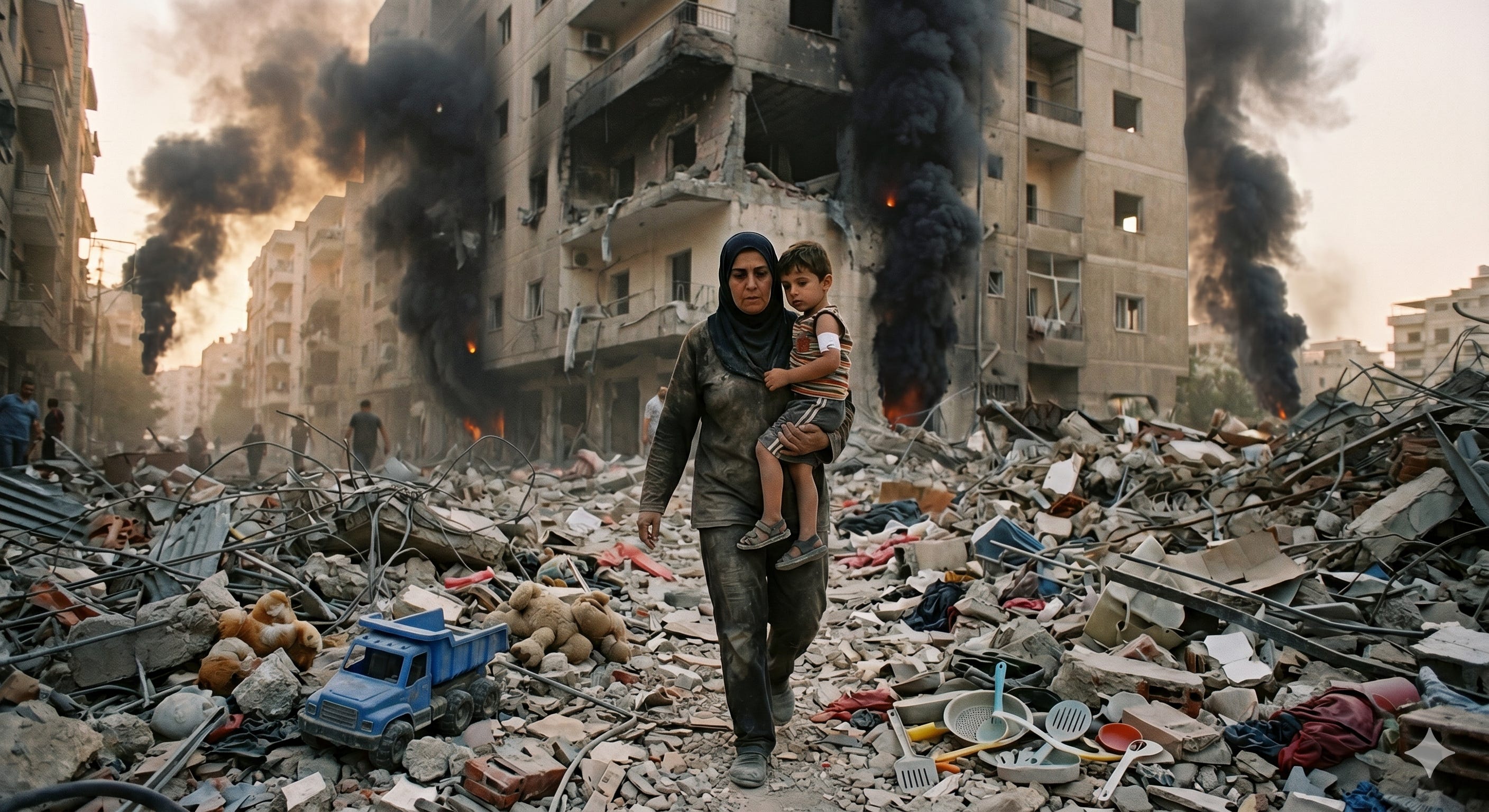
Bearing witness is very different from being a witness. The first phrase implies carrying what you have witnessed in an empathetic manner, one in which you are resonating with the pain of the action/condition you are observing. Being a witness is a simple act of observing and telling others what you saw, which may certainly be horrible and moving. But witness-being is objective. The courts rely on objective witnesses, for example, as evidence that their information is accurate and truthful. Being a witness means carrying information about an act. Bearing witness means picking up and carrying the tragic gap of that act.
In the face of a tragic gap, we need to go beyond reporting the facts, and bear witness.
It’s easier to close our eyes, click our heels three times, and think of home. The American Empire is crumbling in daily chunks, and attempting to take the rest of the world along for its vertiginous downward slide. Who wants to carry that? And what’s wrong with a little nostalgia for a just world?
There are other options. You’ve doubtless already noticed some of those in yourself and others:
Avoidance. An inability to take in the news, period.
Vigilance. A focus on how the media are delivering the news, and what they choose to deliver.
An impatience with those who want to discuss what’s happening.
An obsession with finding out the actual truth/motivation behind the lies. Is it a conspiracy? Incompetence? Corruption? All three?
Fatigue. An inability to take in any more 3am tweets or actions: What’s being covered with gold or concrete or being made too large now? How much is that going to cost, and am I still paying for that in my taxes? Who is benefitting from that death, torture, prosecution, arms purchase?
Distraction. An exclusive preference for consuming benign online content: pet videos, fictional thrillers with redemption/resolution/romantic fulfillment, baking/cooking shows, reality shows with happy endings.
Apathy. “I don’t care, do you?”
You might call these “coping mechanisms’. We are living in tough times.
Bearing witness requires us to handle emotional content over time. If, however, we do not know how to do that, we’ll settle for the coping mechanisms. I know I have.
My experience and my therapists have taught me that the healthy response to uncomfortable emotional content is to accept and process it. So in the interest of learning how to stay healthy while one bears witness in troubled times, I am going to explore a bit of practical advice on the process of dealing with anger, sadness, and fear: three uncomfortable emotions that are connected with survival in hard and dangerous situations.
My go-to on emotional health-- Karla McLaren-- points out that an anger response often arrives carrying (and masking) deep sorrow underneath. This can be especially true for men who have been schooled and trained against displaying sadness. McLaren also points out that the unmasking of that sorrow requires a safe emotional space: a person who accepts and supports you, or an environment where you feel open and free. We covered what we do with the grief underlying that sadness in the previous post.
Fear and anger are connected as well. In that pair, the fear is usually what presents first, as a threat warning, prompting an immediate query: “What am I feeling here?” If the threat materializes and displays as a tragic gap (”ICE is arresting US Citizens now!?”), anger will usually follow: “This is just WRONG!” When one’s fear presents without a flight/fight/freeze message and one’s body moves on to anger, it is usually a sign that there is a tragic gap and we are not (yet) being personally affected by a personal threat.
Some of us don’t want to let go of that anger. We might do that as a way of ensuring that we remain mindful of the tragic gap. Anger carries with it a lot of adrenaline energy; it wakes a body up, stimulates the senses and mental acuity. We may even wish to retain it as a way of identifying ourselves as neither complicit in, nor indifferent to, the violating action.
As a follow-up to that retention, we can dress the anger up: as righteous anger. A sure sign that we are doing that comes when we urgently seek out like-minded people and insist on sharing the news that got us angry. That way, they can get angry alongside us-- or if they don’t, we can get angry with them: Social media posts are rife with righteous anger. It has become an identity marker.
Allowing that anger to stay without transformation is not witness-bearing. It may appear to be a ongoing response to “bad heartedness”. But allowing it to remain is itself a “bad-hearted” response, leading to hatred. The righteous anger response is, for instance, unable to carry compassion for the person(s) responsible for the tragic gap. It is a clear sign that you are no longer witnessing; you are “taking a side” in a conflict that may not even be yours to carry.
Do not waste your anger on bad-hearted people.
When a friend of mine shared this First Nations translation of Psalm 37:1, it made perfect sense to me. Our anger is literally “wasted” when we do not take it through the transformation necessary to the bearing of witness.
How do we begin that necessary transformation?
Here’s one way: When the anger arrives, one needs to welcome it as one would any messenger who is out of breath with carrying news all the way from your emotional depths. Get it to sit down, drink a glass of water and regulate its breathing before you listen carefully to its message.
This step is often called “surrender,” or “letting go.” Before one lets go of an uncomfortable emotion, however, one first has to welcome it, and that’s not an easy task for some of us. These messengers arrive at our doorsteps smelling badly and poorly dressed. We’re inclined to keep them there, maybe thank them for their concern, and close the door. We’d prefer to forget that they are part of us. But the survival emotions are messengers; they’ll camp on your doorstep until they are sure that they have delivered their message.
The next step in the process is to identify my own hidden sadness inherent in the tragic gap, and hold that sadness as lightly and firmly as I can. What is my sorrow connected to? Which of my values does it touch? Do I have some personal history with that tragic gap? If I see a child being abused by its parent, I can know that is wrong at the same time that I am recalling my own role as an abuser or recipient of abuse.
Or it might be that I am a current participant: quietly perpetrating, willingly supporting, or staying silent about the tragic gap I observe. If that’s the case, I need to know -and perhaps do something- about it. As C.G. Jung and his many disciples have pointed out, we have shadows in our selves that fuel our capability for unhealthy behavior. Understanding that, accepting that, and having compassion for that is a sign of emotional health. It can also assist us with the transformative process required for the bearing of witness.
What I observe in a public tragic gap may end up resonating within me to the point where I discover some distance between the values I hold and the actions I take, or attitudes I embrace. I can correct that by connecting one or two new or renewed intentions to the values I know to be right. These corrections are vital, not only for my own integrity, but also for my task of bearing witness.
Whether we are dealing with societal or personal tragic gaps, the final step of preparation for the transformation is to link the tragic gap we have explored with one or more of our personal values. Exploring that gap may even have identified a “new” value that we hadn’t considered before, or a place where we have not linked a value with an intention.
As I pointed out in my last post, there is sorrow in the intentional suffering of navigating the tragic gap. The work of bearing witness requires that we carry it for a while, as we use our values to navigate that gap. This is why I call this first part of bearing witness lamentation. You may remember this quotation from my last post:
...the heart breaks, and the words fall in.
-Hasidic tale
The linkage between the tragic gap and your values is the road “the words” must travel.
In the end, you don’t do the transformation; it does you. Once the transformation has taken place, you have the strength to bear witness: it has become part of who you are. This is how Dr. King could see, in the middle of the tragic gap-- amid snarling attack dogs and vicious, deadly police attacks-- that that the arc of history bends towards justice. This was who he had become.
Where we are headed, are going to need people like that.
The lamentation comes first. That enables us to move to the second phase of bearing witness: testifying.
We’ll explore that together in the next post.
This posts is dedicated to KD, the inspiration for my perspiration.
Great post. Thanks.
As already noted by Joshua, this is a “great post”, AND… one thing that connected for me about both heart related quotes (First Nations translation of Psalm 37.1 -a life Psalm for me- and the Hasidic tale) is the difference between bad-hearted and brokenhearted:
The first has chosen to not allow logos to enter in whereas the second is transformed because logos cannot but “fall in”…oh, may it be that our way be the brokenhearted way… 🎶Let it be, Let it be🎶