The Forecast is For...
Is the War in Iran a Distraction, or a Necessity?

Dear Reader,
If you’ve been following my pieces, you know that I’ve been focusing on our responses to current events as opposed to the events themselves and more importantly, our vocation as human beings living in this time and place. This also means that I haven’t been focusing on tactics to counter the Regime. It’s not that I consider those unimportant; it’s that I want us to consider something that will not only sustain us through these difficult times, but also enable us to rebuild after the ongoing destruction.
This is the second of a three-part series, and it’s an overview. The ongoing destruction is taking place for a number of good reasons, and also--I believe-- in encouragement of one overarching goal. I’ll get back to encouraging us to equip ourselves individually and collectively for that aim, but first I need to explain the stakes. Hint: They are higher than the survival of democracy in the US and in other nation states. That said, the survival of some form of liberal democracy is crucial to the even more crucial task of preserving and supporting human dignity, planet-wide.
In my last post, we considered Samuel L. Huntington’s Creedal Model of cyclical political involvement in the United States. But there are other ways of looking at the cycles that have affected this country. This post is going to consider another one of those, and then look at what we might expect if we could harmonize the combined theories and predict what might come next.

In September 2020, Trump was conducting a campaign for re-election, running against Joe Biden. The election’s outcome was far from predictable. And two political scientists, Jack A Goldstone and Peter V. Turchin, published an essay on the future of democracy, entitled “Welcome to the Turbulent Twenties.“ The article appeared in NOEMA, the journal of the Berggruen Institute.
In that essay, Goldstone and Turchin predicted the unrest of January 6, 2021 that led to the assault on the US Capitol in order to interfere with the ratification of the presidential election results. At the time, most of us thought Trump would never go that far. The essay’s authors knew that it was one of a few inevitable outcomes to a close election, predicting not only January 6, 2021, but also events that have since taken place as well. Again, written in September 2020:
If Trump loses, he is likely to contest the outcome as a “rigged” election. But that action will again lead to massive popular protests, this time to insist that the election results be honored. If Trump again puts federal security forces in the streets, governors may ask their state troopers or even national guard to protect their citizens and defend the Constitution. Or Trump may call on his many armed civilian supporters to defend their “all time favorite president” (as he put it) against so-called “liberal tyranny.”
Pretty accurate.
Who are these scientists, and how did they arrive at these predictions? Both of them are historians and political scientists. Turchin has been particularly focused on creating mathematically-based models that predict the rise and fall of countries and empires.
Here’s how they applied their models to our country:
In applying our model to the U.S., we tracked a number of indicators of popular well-being, inequality and political polarization, all the way from 1800 to the present. These included the ratio of median workers’ wages to GDP per capita, life expectancy, the number of new millionaires and their influence on politics, the degree of strict party-line voting in Congress, and the incidence of deadly riots, terrorism and political assassinations. We found that all of these indicators pointed to two broad cycles in U.S. history.
In 2016, Turchin published “Ages of Discord,“ his book in which he tracked cycles of stability and instability by creating and quantifying two modeled indices: Well-Being and Political Stress. Here is how the ensuing 2020 article represents it graphically for the U.S.:
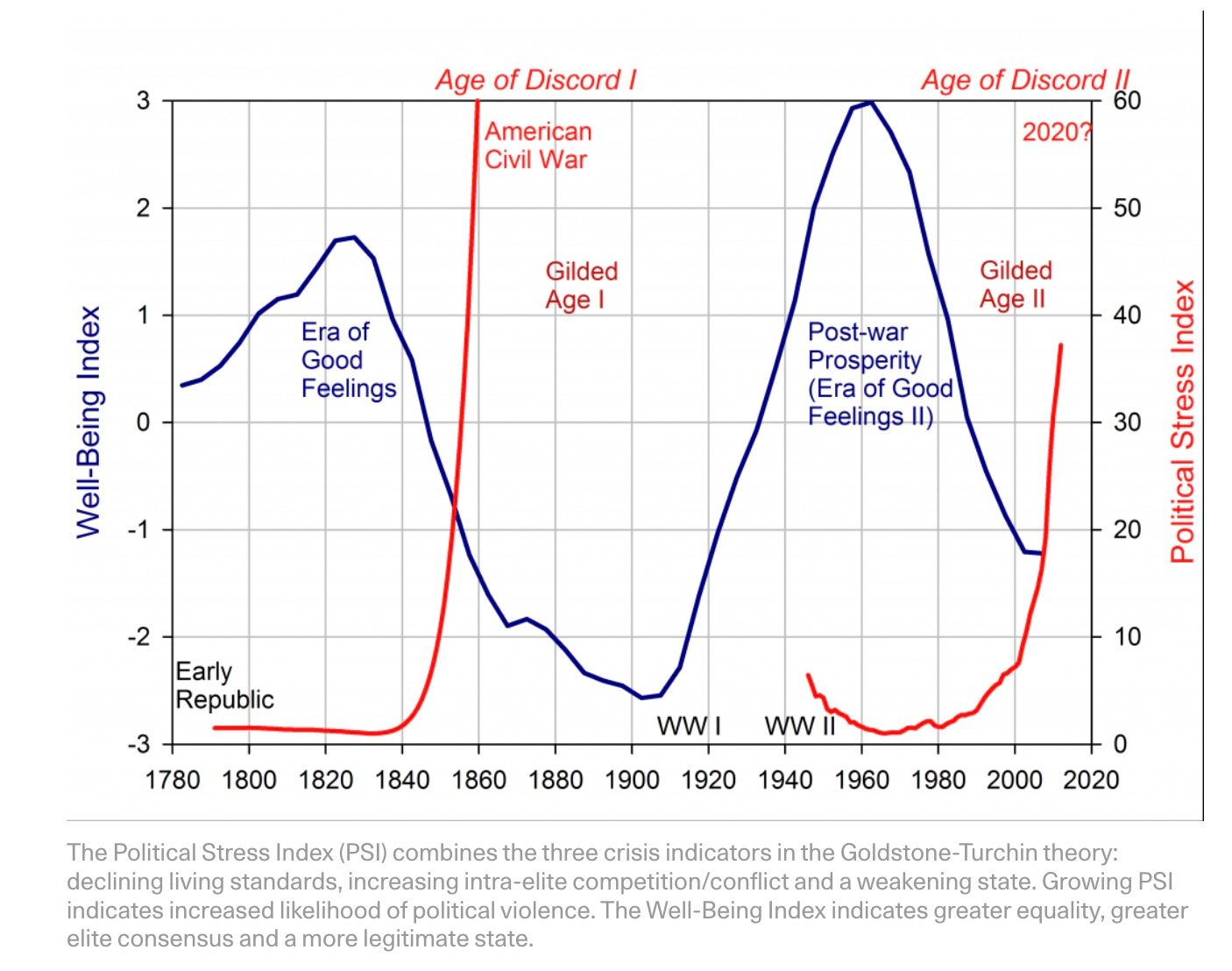
You’ll note the rising red line of political stress on the right-hand side. The article I’ve quoted above was published four years later, warning that the Political Stress Index was only going to increase, regardless of who was about to be elected, even though the authors point out:
Top leadership matters. Leaders who aim to be inclusive and solve national problems can manage conflicts and defer a crisis. However, leaders who seek to benefit from and fan political divisions bring the final crisis closer. Typically, tensions build between elites who back a leader seeking to preserve their privileges and reforming elites who seek to rally popular support for major changes to bring a more open and inclusive social order. Each side works to paint the other as a fatal threat to society, creating such deep polarization that little of value can be accomplished, and problems grow worse until a crisis comes along that explodes the fragile social order.
When we harmonize the two theories, we see that our current decade shapes a “perfect storm:” Huntington’s psychological crisis and Turchin’s structural economic crisis converge to threaten the very existence of the US as a democratic republic. It may turn out that the US is not “too big to fail.”
What are the future possibilities? Here are three of them:
Scenario A: The “Inter-Elite” Break Turchin warns that the most dangerous moment is when “counter-elites” (the highly educated who are shut out of power) finally break the system to let themselves in. This usually involves a period of high-level political “purges” or radical restructuring of the government.
This one has already happened; it’s what Project 2025 is all about.
Scenario B: Institutional Decay If the “disharmony” remains high but no structural reforms are made, the U.S. might enter a “Long Slide.” This is a state of permanent dysfunction where institutions continue to lose legitimacy (Huntington) and the state becomes unable to manage basic functions due to fiscal distress (Turchin).
Note the comment “...but no structural reforms are made.” If we end up with a peaceful transfer of power at the end of 2028, whoever takes charge will have to make that reform. In other words, we have to reinvent liberal democracy in the US, and somehow partner with federal conservatives and state governments to create that reinvention. Former members of Congress don’t believe that will be possible in the current political climate, nor that of the near future.
Scenario C: The “Great Re-alignment“ If the current “Creedal Passion” (Huntington) forces a new set of elites to take power and implement structural changes (Turchin), the 2020s could end with a new “Social Contract.” This would involve a shift in how the economy works to stabilize the masses. Specifically, what Turpin calls the “wealth pump,” the mechanism that continuously siphons wealth from the working and middle classes and concentrates it in the hands of a small ruling elite, must be addressed and altered.
This is what the political pundits are urging the Democrats to do in 2028, after Trump’s last term. (The Regime’s current (and illegal) war on Iran may very well work as a strategy to prevent this scenario from happening.)
These scenarios are just the domestic picture. Other liberal democracies around the world are struggling as well, and experiencing their own right-wing populist pressures. Add to that:
Struggles by almost every liberal democracy (England, Canada) to provide nationalized health care
The current souring of Australians, a nation of immigrants, on immigration
The environmental concerns from an increasingly rapid climate change, leading to further immigration issues
World-wide changes in manufacturing employment, driven by robotics
World-wide changes in white collar labor employment, driven by AI
The use of cryptocurrency to internationalize the movement to concentrate and privatize wealth.
It’s almost certain that none of the above issues are ones you and I can personally address. But neither should their existence immobilize us into an inactive entropic trance. I’m not suggesting the inevitable end of the world. There is another, even more powerful counter-movement for us to understand first.
That’s for the next post.