Why Am I Still Here?
You do not need to know precisely what is happening...

My mother-in-law Adeline was one of those women. Married to a returning vet towards the end of World War II, she kept working as a secretary even after she gave birth to their only child. My wife was brought up by her maternal grandparents, while both of her parents worked. Adeline continued working. By the time she retired, she was an executive assistant at General Electric.
She and her husband moved to Florida and made a life for themselves in the Orlando area. Eventually, Adeline’s husband died, and --always the social one in the couple-- she made a life of her own there.
As her health declined, we would visit more often, eventually persuading her to move across the country to where we lived. She would often express impatience at still being alive, with less and less ability to do anything. She passed away, less than six weeks after her move.
“Why am I still here?” she would ask, whenever we celebrated a birthday. The best response my wife and I had was that we were glad that she was.
But that wasn’t answering her question: She wanted to be of use, and that life--the one she spent most of her life living- seemed to be far behind her. She was a woman of faith, and the next life she anticipated was both eagerly awaited and frustratingly distant.
This quest for usefulness has a bit of a downside for some of us.
Thomas Merton points to a different way of answering the question of being useful:
You do not need to know precisely what is happening, or exactly where it is all going. What you need is to recognize the possibilities and challenges offered by the present moment, and to embrace them with courage, faith, and hope.1
But we ask, what does our “present moment” have to do with the War in Iran, the devastation of Gaza, the desperate stubborn defense of Ukraine, the denial of climate change and vaccine efficacy, the violation of the rule of law by US government agencies, federal agents openly and illegally killing US citizens, the blatant corruption and scoff-law behaviour, both evident and unchallenged at the highest levels of the US Government... I’ll stop there, shall I? The list is both too long and woefully incomplete.
These days, these things are always asking for our attention.
When Merton points us towards “the present moment,” he is asking us to refocus our attention. Not because the larger questions are above our pay grade, or because worrying about the bigger picture is a waste of time, or because there is nothing practical you can do.
Quite the contrary.
Putting our attention on the present moment and applying our values and skillful means is the most practical thing we can do. It is also the one most available to us, and uniquely ours.
But is being present the most responsible thing to do? It isn’t.
It is the only responsible thing you can do. Being present and making the magic: that thing that we humans are equipped to do, but rarely know when we are doing it: allowing the life through, and letting the transformation take place.
The present moment is yours, and yours alone. What local magic could you make with it?
A friend from far way calls with bad news about her latest diagnosis. What extra-local magic could you make by being attentive in real time, and yet physically distant?
Being present does not necessarily mean being in the same room. But working the magic does require presence.
The re-focusing is key to entering the process of being present. It’s not a matter of knowing which problem to solve: one cannot engage a problem which is not there, after all. And if you are not present, that distant problem isn’t there either. It’s just something your mind grabbed onto, suggesting it was more responsible than “being present”, and you agreed.
Our ability to be informed in almost real time about important events that take place far away from us has made it more difficult to be present. The media we consume have theirfinancial and existential reasons for requiring our attention, and they use everything in their power to get it.
Are we better informed, or overly inattentive to our presence, as a result? The answer to both questions is “yes.”
Further: this highly connected, mobile, and informed environment uses fear and anger to get our attention, making it difficult to focus on being present without questioning the worth of doing so, raising the issue of our personal responsibility.
Working the magic requires presence.
Thomas Merton was opposed to both the Cold and the Vietnam wars and began writing open letters on the topic. After 1962, his religious superiors told him to stop doing so. They maintained that it was distracting him from his true contemplative vocation as a Trappist monk. And they encouraged him to explore contemplative work in other cultures and religions.
Merton wrote for publication on contemplative topics. He began and maintained an East-West interfaith dialogue on contemplation that is still actively productive today. He also began privately corresponding with the social activists: Dorothy Day, Daniel and Philip Berrigan, and others. He provided them with advice, critique and spiritual support. What impact do you suppose his presence-
Hang on: Our dog Sofia is asking for my attention...
--
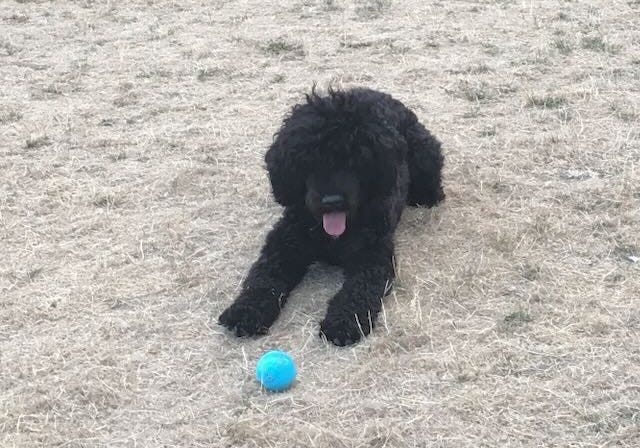
Okay, I’m back. Every so often, Sofia reminds me to move away from my writing screen and do something with/for her. This time, it was tossing a ball in our backyard so she can retrieve it; an exercise that always ends with a freshly-made ice cube to chew when she returns. We’re both getting old; our bodies need the exercise and hydration, however brief or small.
I can’t write about the present moment without being there myself. When I was present to Sofia, I was doing nada for world peace, the rule of law, or poverty in my community-- all of them important issues with which I am concerned. I wasn’t even writing for you, dear reader.
My present moment was asking for something else. And I made the decision to meet it.
Why am I here?
I’m here to toss the ball.
-Thomas Merton, Conjectures of a Guilty Bystander (1966)
I am here to toss the ball. Reminds me, it's time to go pet the cat.