Why Am I Here?
Peaceful co-existence is no longer possible without reciprocal understanding.

I’m staring at my shoes. They’re so…polished. The sharp crease of my suit pants breaks perfectly on the sheen.
Across the desk, a senior partner at a large Canadian law firm is holding forth. I look up, make eye contact—I know I’m supposed to—while my foot keeps swaying under the chair.
I’m the Producing Artistic Director of Theatre & Company, responsible for both the business and the artistic vision. Beside me sits our Director of Development. A group of theatre artists (including my wife) and I founded the company in Kitchener, Ontario, Canada in 1988. We started as a small repertory ensemble; at this point in the story, we’re a regional theatre. Thanks to a loyal group of supporters—and against all odds—we’re about two years into our brand-new, expanded-capacity, purpose-built $4.1 million theatre space.
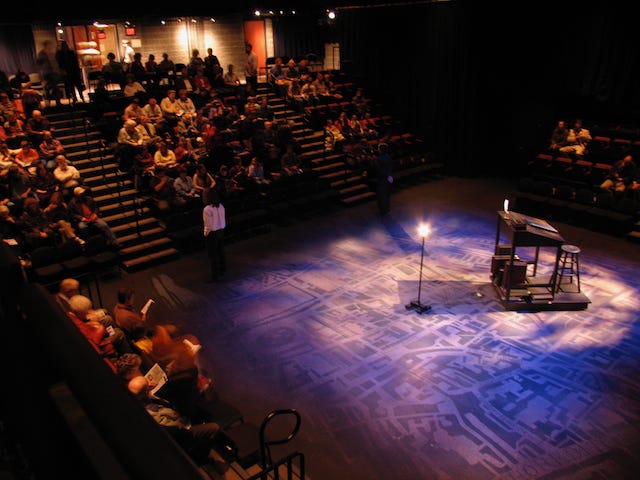
Everything is as it should be, but my swaying foot tells me I have an unspoken question:
Why am I here?
My surroundings offer a ready answer. The firm is interested in supporting a production in our upcoming season, but—as my Director of Development told me before we left the office together—they’re requesting perks we’ve never granted before. Because she knows me, she wants me to hear the proposal firsthand, and she wants me to be the one to refuse its terms, if that’s what I decide.
That’s why I’m here. Apparently. So I listen.
The senior partner wants me to understand how many clients they have, how well connected they are, and—by inference—how fortunate we are that they’ve chosen us for philanthropic support. They want one night of the run as an exclusive performance for themselves, their staff, and their clients. They expect every seat to be filled. Most of the people attending this free performance have never set foot in our theatre—and they’re exactly the kind of future audience members we want.
The firm plans to bring in their own catering firm, setting up open bars and food stations in our lobby. That’s the part we’ve never done.
“Looking at the season,” our Director of Development says, “we have Crossing Delancey, a romantic comedy… That might be ideal for what you have in mind. Right, Stuart?”
I nod, thinking, I knew this day would come, right on the heels of that custom-built flex theatre space. The potential loss of concessions income is more than made up for by the firm’s contribution. As expected, I agree, and I pronounce the theatre delighted at being chosen for the opportunity. We shake hands and smile. Everyone leaves pleased with the outcome.
But back in my office, alone, I know that’s not actually why I’m here. I go over it in my head: I’m here because I believe in the power of community imagination; because when the stage lights rise, the audience suspends disbelief as the the actors believe; because the resulting laughter, astonishment, and tears can ripple outward into everyday lives. I’m here because this city deserves a place devoted to its dreams, fears, and apprehensive hopes—and because when those theatre artists go home, they should be able to eat, and afford a comfortable place to live.
And a group of us have put skin in the game. My family and I have made the necessary sacrifices to keep this work alive, alongside ensemble members and board members who have done the same. Perhaps any of us could have chosen otherwise—but when the next challenge arrived, we met it. And we kept going.
Months later, Crossing Delancey opens, to the mildly positive critical response and strongly positive popular response that often greets comedic theatre works. During the second week of the run, I drop in on the law firm’s night out at the theatre, arriving just before the intermission. I could see the firm’s private catering staff had set up the open bars and food tables.
Arthur, our house manager extraordinaire, is watching them set up. He takes me aside to let me know that the catering company had arrived early and opened their bar before the start of the show. Neither of us had been informed of that detail. We shrugged.
As the house doors opened and the audience streamed out, I greeted the firm’s senior partners and the few guests I already knew. People seemed to be glad to be there.
But as I observed our patrons more closely, this was no regular night. These people were engaged in the hilarity of their conversations and the conviviality of their food, and--especially, I noted-- of their drink.
It was part of Arthur’s job to keep our intermissions to 15 minutes. On nights when the house was especially full, the ushers had an extra five minutes’ grace to get stragglers into their seats for the next act, but that was the most we would allow, and the house manager was required to inform the stage manager of the delay. If we had more than a few disabled patrons, or a bathroom was out of order, for instance, more time might be required. Arthur was skilled at handling stragglers. He used his knowledge to train his ushers well, and bent to the task himself.
Tonight, Arthur struggled.
When the theatre seats finally filled 30 minutes later and the houselights went down, people were talking loudly and laughing. They’re having a good time, I thought. They’ll quiet down eventually. I went home.
The next day, a cast member in the production, and a member of our acting ensemble, walked into my office. He was furious: Did I know what happened last night? The cast was held backstage overtime for the second act; as he saw it, that was bad enough. But he saved his real anger for the audience’s behaviour during the second act, and that had been caused by my decision to allow the open bar.
Comic timing is a delicate matter for theatre actors. The different bouts of response-- laughter, giggles, guffaws-- are rhythmic cues for the actors, who must take them into account as they work onstage. Each audience in the run of a comedy is different, but by a certain point in the first act, the actors have usually figured out how to work the performance’s rhythms. This audience was so drunk and so openly besotted with themselves that the first half of the second act had been a disaster of missed opportunities for the very work that we all prized. The actors were unable to do their best, and entered damage control mode onstage.
In closing, the ensemble member blamed me for agreeing to the deal that (to my mind) had supported the show’s existence in the first place, not to mention his salary.
I was shocked, but not surprised. The theatre ensemble and I had held many discussions before deciding to transform from a small group into a professional theatre with a resident acting company. I had informed our ensemble members that the move was going to need ongoing support, and that there would be compromises. At the time, they assured me that they understood that.
From where I sat, this was just one of many compromises along the way. It’s how life is lived.
I see it differently, now. The whole point of my leadership was not only to ensure our continued existence, it was to ensure that we could continue to create artistic work to our collective standards. The producer in me had values and standards that the artistic director I was did not share.
My jiggling foot had warned me of the inner conflict. The law firm was looking to give people a good time in a fun venue; it was a fair bet that a comedy in a prestigious theatre space was going to do that, and that their visible and tangible support of artistic work would help further their standing in the community. The open bar would just be a sign of their hospitality. My foot knew that-simultaneously- it could also become something else entirely.
If you have been following this Substack, you’ll remember the emphasis I have been placing on conscious values, intentions, and attention.
The aggregate effect of living out our values is that our consciousness provides a worldview. A worldview in which certain things take priority, into which we invite certain friends and decide whether our neighbors are supporting an environment in which that consciousness can thrive. Our neighbors have their own worldviews. They are asking themselves the same question about whether we are contributing to a healthy environment for them.
Our world is filled with people who have different sets of values and priorities. If we want to live in communities where we can connect, we need to become aware of those differences. And this world is getting smaller and our communities are getting closer together, even when they are physically far apart.
And we’ve been witnessing the resulting collisions.
If we zoom out of this picture a bit, we see that this is happening in the United States, and in other countries. Zoom out a little more, and we see it happening internationally.
(Ironically, that zooming out is made possible because the Internet has brought us closer together.)
“Why am I here?” Each answer seems unique, but when we look more closely, we see that components of your answer look just like components of mine.
We negotiate these aggregate values every day. When I am driving my car, I value my safety and that of my passengers. The car behind me may have a driver who also values their safety, but their pressing need to be somewhere values speed more. They’re willing to pass me on a two-lane road, on a rising hill without full visibility of oncoming traffic. We have no idea which values are held by the driver of the third car which is climbing towards us on beyond our vision on the other side of the hill, and no way to know what they are.
Each driver has a different idea of why they are on the road, and what they are willing to tolerate in order to accomplish their goals.
If the driver behind me decides to pass, all three drivers are in a risky situation, because one of us has a greater tolerance for risk. This could turn out to be a minor annoyance, a scary situation, or a possibly fatal experience.
We need to be able to share the road; we have traffic laws and rules and police to help us do it. But the most important thing we can individually bring to that need is an understanding that we are likely sharing that road with people who have differing values and hold them differently.
As we continue this series, I’m going to keep considering this:
Dignity is the birthright of each and every human being.
And this:
Unity is no longer possible without diversity.
And, finally this:
Peaceful co-existence is no longer possible without reciprocal understanding.
As an exercise, we’re going to try to hold these considerations simultaneously.
I’ll remind us as we go.
Just this evening I shared with a security guard (who has been criticizing the behavior of a fellow shopper) my theory on the frustrations of LA traffic which, if I let it, can reduce my foul outburst at those who share the road with me. LA enjoys a population drawn from, quite literally, at least 80%, perhaps more, of the countries on Earth. The drivers in LA learn their "rules of the road" in different places with different cultures and different tolerances. What to me violates the laws I was taught (and the set of them I follow and expect others to follow) could be completely in line with driving in Nigeria, Russia, France or Mexico or Seoul or Paraguay. In Mexico City, for example, a three lane road turns into five during rush hours, the lines in the roadway completely ignored then. I has nothing to do with speeding things up. To the contrary it causes frequent chaos and produces impossible choke points. But, it's fine. LA, though, differs in an important respect. Other places like New York City or London are filled with citizens willing to take on the job of correcting anyone breaking local rules. I've been yelled at in France even in a sleepy coastal town in the south under a relaxing sun. But in LA, we just let it be and tend to yell in the car, windows closed, air conditioning on. Inherently we are either irresponsible or understanding.
Stuart,
Just so well written and perceptive of the greater and lesser things we have to deal with each day. 'You have to go along to get along." how many times have we heard that? And so how far are you willing to go along without violating your conscience and personal red line? This piece touched me personally because I was in a car accident in December by a vehicle that was speeding. Five young people in the car, Only two wearing seat belts, the minor girly in the back seat was thrown out the front window and the driver had no insurance. I sustained two fractured vertebrae. I am pretty well healed now. We REALLY ARE all in this together!